Pale Lilac Color
Pale Lilac Color Values
What Does Pale Lilac Mean?
Pale Lilac belongs to the purple family of colors. Purple dye once cost more than gold, and the royal association never really wore off. The family blends red's warmth with blue's calm, which is an odd, appealing combination. Brands pick purple partly because their competitors don't. As a lighter shade, Pale Lilac reads as airy and understated, comfortable working in backgrounds and across big surfaces.
In the ISCC-NBS color naming system, Pale Lilac is classified as a gray (nearest centroid: very light violet, #DCD0FF). It is also known as Lens Flare Pink.
Color Harmonies
Complementary
Analogous
Triadic
Colors That Go With Pale Lilac
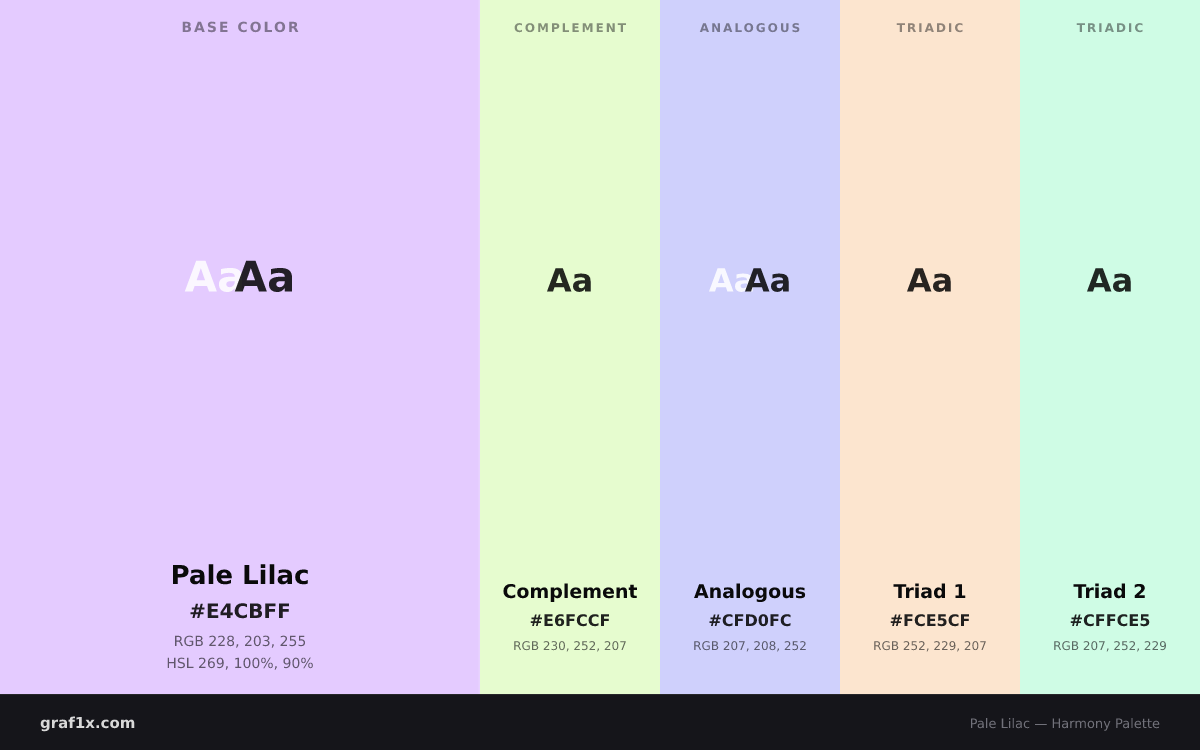
Pale Lilac and #E6FFCC are complements, parked opposite each other on the wheel. Together they hit maximum contrast, so a rough 70/30 split keeps the pairing from shouting.
Analogous neighbors — #CCCDFF and #FECCFF, which sit beside pale lilac on the wheel. Pairings like this feel calm and settled, which suits backgrounds and gradients.
For an energetic three-color palette, pair pale lilac with triadic partners #FFE5CC and #CCFFE5. All three sit evenly spaced around the wheel, so the scheme stays lively without clashing.
Build and test these combinations in our Color Wheel Tool or check text readability with the Contrast Checker.
Pale Lilac Color Combinations
Explore two-color pairings with harmony analysis, contrast ratios, and CSS design tokens.
Browse all color combinations →Tints and Shades
Tints (lighter)
Shades (darker)
Similar Colors
- Light Lavender —
#DFC5FE(Delta E 3) - Pale Lavender —
#EECFFE(Delta E 4) - Light Lilac —
#EDC8FF(Delta E 4) - Very Light Purple —
#F6CEFC(Delta E 6) - Perfume —
#D0BEF8(Delta E 7)
CSS Examples
.text { color: #E4CBFF; }
.background { background-color: #E4CBFF; }
.border { border: 2px solid #E4CBFF; }
.shadow { box-shadow: 0 4px 6px #E4CBFF40; }
WCAG Contrast
Frequently Asked Questions
What is the hex code for pale lilac?
Pale Lilac has the hex code #E4CBFF. In RGB notation it is rgb(228, 203, 255), in HSL it is hsl(269, 100%, 90%), and its OKLCH value is 0.88, 0.075, 306.7.
What does the color pale lilac mean?
Purple-family colors like pale lilac carry distinct psychological associations. Pale Lilac belongs to the purple family of colors. Purple dye once cost more than gold, and the royal association never really wore off. The family blends red's warmth with blue's calm, which is an odd, appealing combination. Brands pick purple partly because their competitors don't. As a lighter shade, Pale Lilac reads as airy and understated, comfortable working in backgrounds and across big surfaces.
What colors go with pale lilac?
Pale Lilac has three easy routes: its complement #E6FFCC for punch, its neighbors #CCCDFF and #FECCFF for something calmer, or triadic partners #FFE5CC and #CCFFE5 when you want energy.
Is pale lilac a standard web color?
No — Pale Lilac is not a CSS keyword. Use its hex value #E4CBFF or any RGB/HSL equivalent in your stylesheets.
How do I make pale lilac lighter or darker?
To lighten pale lilac, add white to create tints; to darken it, add black to create shades. The tints and shades table above shows five computed steps of each, from #FAF5FF (lightest tint) to #25004D (darkest shade).
About Pale Lilac
Pale Lilac is classified as a Gray in the ISCC-NBS color naming system, within the Purple hue family. It has alternative names including Lens Flare Pink. The color is recognized by XKCD, meodai.
Use our Color Converter to convert #E4CBFF to any other color format, or explore the Color Wheel to find harmonious color combinations.