Sand Color
Sand Color Values
What Does Sand Mean?
Sand belongs to the yellow family of colors. Yellow is the brightest thing in daylight, which makes it impossible to ignore and easy to overdo. School buses and hazard tape exist to exploit that visibility. In artwork, small amounts of yellow energize a piece; large fields of it tire the eye surprisingly fast. Sand sits at a mid-lightness, which keeps it readable on both white and black without much fuss.
In the ISCC-NBS color naming system, Sand is classified as a yellow (nearest centroid: light yellow, #F8DE7E).
Color Harmonies
Complementary
Analogous
Triadic
Colors That Go With Sand
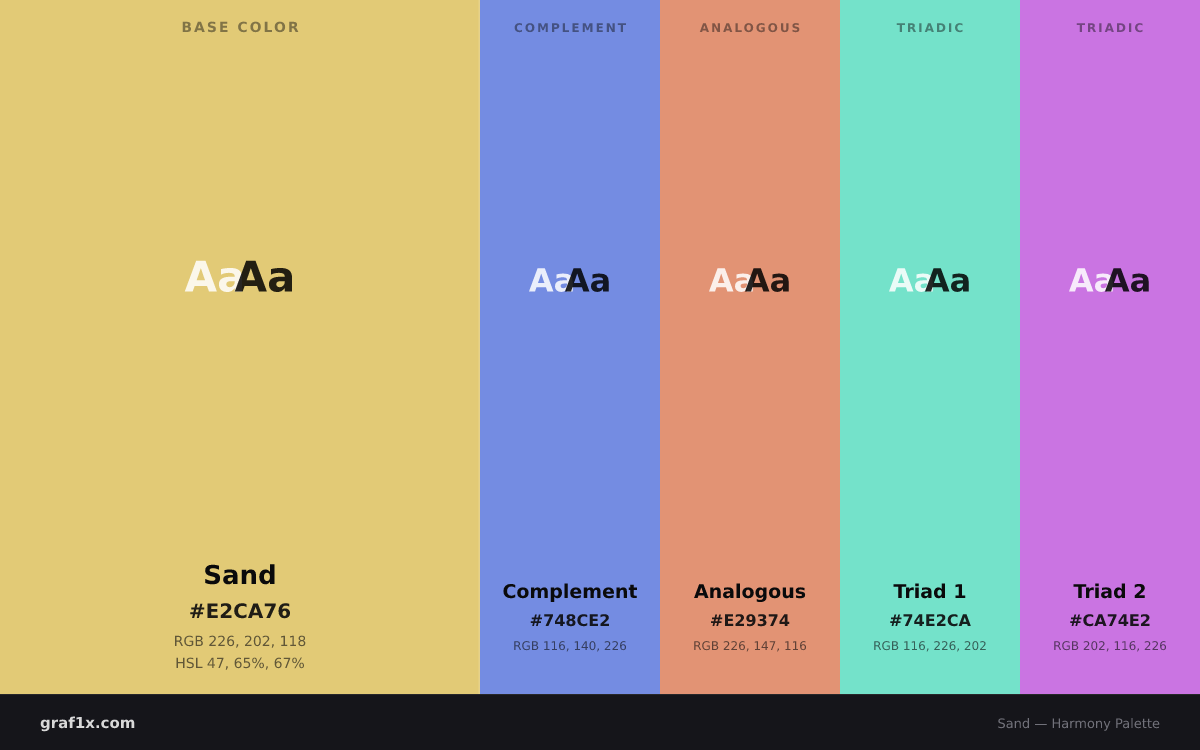
Sand and #748CE2 are complements, parked opposite each other on the wheel. Together they hit maximum contrast, so a rough 70/30 split keeps the pairing from shouting.
Analogous neighbors — #E29374 and #C3E274, which sit beside sand on the wheel. Pairings like this feel calm and settled, which suits backgrounds and gradients.
For an energetic three-color palette, pair sand with triadic partners #74E2CA and #CA74E2. All three sit evenly spaced around the wheel, so the scheme stays lively without clashing.
Build and test these combinations in our Color Wheel Tool or check text readability with the Contrast Checker.
Sand Color Combinations
Explore two-color pairings with harmony analysis, contrast ratios, and CSS design tokens.
Browse all color combinations →Tints and Shades
Tints (lighter)
Shades (darker)
Similar Colors
- Rob Roy —
#EAC674(Delta E 5) - Chenin —
#DFCD6F(Delta E 5) - Apache —
#DFBE6F(Delta E 6) - Golden Sand —
#F0DB7D(Delta E 7) - Sandy —
#F1DA7A(Delta E 8)
CSS Examples
.text { color: #E2CA76; }
.background { background-color: #E2CA76; }
.border { border: 2px solid #E2CA76; }
.shadow { box-shadow: 0 4px 6px #E2CA7640; }
WCAG Contrast
Frequently Asked Questions
What is the hex code for sand?
Sand has the hex code #E2CA76. In RGB notation it is rgb(226, 202, 118), in HSL it is hsl(47, 65%, 67%), and its OKLCH value is 0.841, 0.108, 93.9.
What does the color sand mean?
Yellow-family colors like sand carry distinct psychological associations. Sand belongs to the yellow family of colors. Yellow is the brightest thing in daylight, which makes it impossible to ignore and easy to overdo. School buses and hazard tape exist to exploit that visibility. In artwork, small amounts of yellow energize a piece; large fields of it tire the eye surprisingly fast. Sand sits at a mid-lightness, which keeps it readable on both white and black without much fuss.
What colors go with sand?
Sand has three easy routes: its complement #748CE2 for punch, its neighbors #E29374 and #C3E274 for something calmer, or triadic partners #74E2CA and #CA74E2 when you want energy.
Is sand a standard web color?
No — Sand is not a CSS keyword. Use its hex value #E2CA76 or any RGB/HSL equivalent in your stylesheets.
How do I make sand lighter or darker?
To lighten sand, add white to create tints; to darken it, add black to create shades. The tints and shades table above shows five computed steps of each, from #FBF7EA (lightest tint) to #2E260A (darkest shade).
About Sand
Sand is classified as a Yellow in the ISCC-NBS color naming system, within the Yellow hue family. It has The color is recognized by XKCD, meodai.
Use our Color Converter to convert #E2CA76 to any other color format, or explore the Color Wheel to find harmonious color combinations.